
On Slavery
The first question arises: whether in a totally morally nihilistic environment where survival and resource acquisition is the only goal, slavery is after all really bad or not? Because whether it’s bad or not totally depends on the time in evolutionary history we are looking at. We only consider this bad now because we have ultimately decided as a species that, as a conscious species, we have to treat each human equally even if resources are limited, or even if one is more powerful than the other. But this deduction is the result of long history that has to be understood through a lens of motive to understand how we decide on any moral matter.
Disclaimer: All these ideas are my own and they can change totally with time based on my understanding.
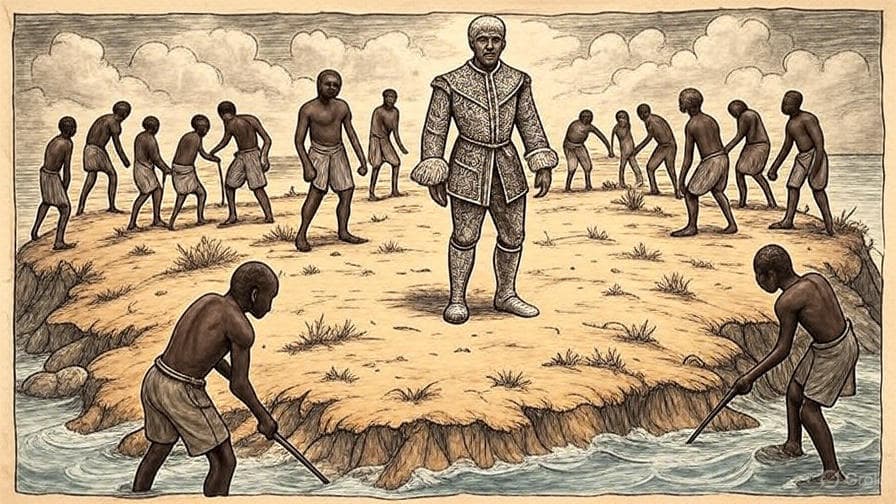
Imagine Earth with all the water except just one island in its center. Everything around this island is water, no place to go, no piece of land to visit elsewhere. For the argument's sake, just think that the sea level rose to a point that only this island survived out of all because it was a little higher than the other land. I know this is just a weird example but I am setting up a premise to communicate a point.
On this island, some are physically weak, some strong, some with very large stocks of food and resources, some hungry and starving, and some may be outcasts. Life starts happening, and keeping in mind that all of them are humans, human nature is still intact and will show its evolutionary behavior soon enough. People start mating to further grow what’s left of the human species. Now the number of potential mates is limited, which gives rise to a supply and demand gap leading to a large conflict. Similarly, food is limited but hunger for it is increasingly more, hence creating a supply-demand gap again. What would happen now on this island?
Considering that this little environment of the island hasn’t decided on its codes and morals yet, we can observe all the subsequent behaviors in light of a totally morally-free construct of society. The only morals that can exist at this moment in action form would be to help the most powerful and most resourceful one achieve the maximum benefit of his possessions. Hence he or she will ultimately need to enforce behavior that saves resources, guarantees maintenance of power, and removes behavior around him that can become a threat. As we know, there is supposedly no governing body to monitor his own behavior. This pursuit of power and resources ultimately guarantees the invention of slavery to enslave as many people as possible so maintaining power and resources would be easily guaranteed.
Consequences
Slavery, in the basis, is the eventual consequence of a morally free environment based on true human instincts. So if the goal really is to find suitable moral rules and codes, we have to filter out what constitutes instinctive rules (rules that will be followed regardless of the environmental design) and enforced rules (that have to be enforced to override basic evolutionary instincts). As we understood by our example, slavery is the automatic eventual consequence of a resource-limited morally free environment, we have to understand further what will be the long-term consequences that pose a need for its removal and how we can do that.
The first question arises: whether in a totally morally nihilistic environment where survival and resource acquisition is the only goal, slavery is after all really bad or not? Because whether it’s bad or not totally depends on the time in evolutionary history we are looking at. We only consider this bad now because we have ultimately decided as a species that, as a conscious species, we have to treat each human equally even if resources are limited, or even if one is more powerful than the other. But this deduction is the result of a long history that has to be understood through a lens of motive to understand how we decide on any moral matter.
Religion
From the example we discussed at the start, we know that it is the ultimate consequence if left unchecked, so accepting it is the first course of action. This is the sole reason it was accepted as a totally morally right construct to exist, because otherwise all resources would be depleted in maintaining equality and the species would cease to exist (at least as far as the belief is considered). Here comes religion and its long history of allowing and putting strong regulations on conduct of slavery.
Of course, non-religious folks now look back in history and consider religion as somewhat a promoter of slavery, and hence believe they are somehow morally superior to all the religions that didn’t demolish slavery as a practice while they did. But they commit a big mistake ignoring the fact that religion is not actually a promoter or an initiator of slavery, but religion is simply just a genius way of regulating evolutionary human instincts to sustain a flourishing civilization and set accountability for the powerful ones who otherwise can lead to demise of the species as a whole. Because unregulated slavery is the ultimate medicine of chaos and destruction. Religion didn’t abolish it outright because then it wouldn’t become legitimate enough in the minds of the powerful to be taken seriously. So not abolishing instantly is the wise way to decrease the amount of destruction created by the act of slavery. Also, one of the biggest goals and achievements of religion was provoking cooperation instead of dominance. Religion provoked the cooperation side of human instincts and regulated the dominance part, which eventually resulted in sustained growth for humanity.
But how unregulated slavery is the ultimate medicine of chaos and destruction? Let’s explain this further.
Unregulated Slavery
If we continue the example given at the start, in an uncontrolled morally free environment when the powerful and resourceful have achieved control, the basic human instincts of "having it all and winning it all" will just make it worse than expected eventually. Because when we continue this arc of constant shifting of resources and power to one source and enslaving of all other entities participating, two or three things can happen eventually and all of them will result very, very badly for the species.
First one is the death of that single powerful one, which will cause an instant disruption in the cycle of demand and supply that was being filled and maintained by the dead one. Now either all slaves will kill each other over resources and power, or all resources will be depleted in all unknown wasteful behaviors and nothing will be left for the species to survive.
Second could be the rebellion of slaves against the one true powerful one, which is just as bad because who will be the next enslaver? The same pattern of one powerful one enslaving all others repeats until the species goes extinct.
Third could be usage of resources on the most wasteful and short-term behaviors by the powerful one because there is no filter and no guarantee that the powerful one would be wise enough to think long-term and selflessly about all other human beings. This consequence is the worst of all because there is not even any effort involved for freedom or change of order in the hierarchy. It’s just a dystopian end of the species.
The motive of this piece of writing wasn’t to pose slavery as an inevitable consequence but to make the importance of religion and its rulings about slavery a justified construct of long thought and evolved wisdom. Religions, no matter what you believe about them — either that they are from God himself or that they are man-made moral codes — are still one of the most profound ways of controlling and molding evolutionary human instincts for the maximum probability of survival of the human species and the sustenance of the greatest civilizations in history.
This is not only applicable to the subject of slavery but also to any other ruling that was historically a part of religious doctrine but is now regarded as immoral behavior. So at last I would say that all moral decisions are only contingent upon how a group of humans define them, and making judgments on any such behavior requires deep understanding of why a behavior existed in the first place.
Counter Argument:
A counter argument that can be made is that slavery isn’t the ultimate consequence always, cooperation is also just as rooted in human instinct as the need to attain power. We will talk about this argument in the next article in detail.
To Ponder:
My question for you: Do you think religion’s legitimization of slavery is justified or not?